Your startup name is more than a label—it's the foundation of your brand identity, your first impression with customers, and often your most valuable trademark asset. Yet most founders approach naming backwards, falling in love with unavailable names or choosing words that limit their growth.
This guide will take you through a battle-tested process used by successful founders to find names that are memorable, available, and built for scale.
Why Your Startup Name Matters More Than You Think
According to research from Stanford Graduate School of Business, a company's name significantly impacts investor perception, customer trust, and even stock performance. Names that are easy to pronounce generate more positive investor sentiment—a phenomenon researchers call the "fluency effect."
But here's the paradox: while naming matters enormously, spending months on it is often counterproductive. As we explored in Why Execution Beats Perfect Branding, Reid Hoffman's advice to "launch when you're embarrassed" applies to naming too. The goal isn't perfection—it's finding a name that's good enough to build on.
The Four Naming Frameworks Every Founder Should Know
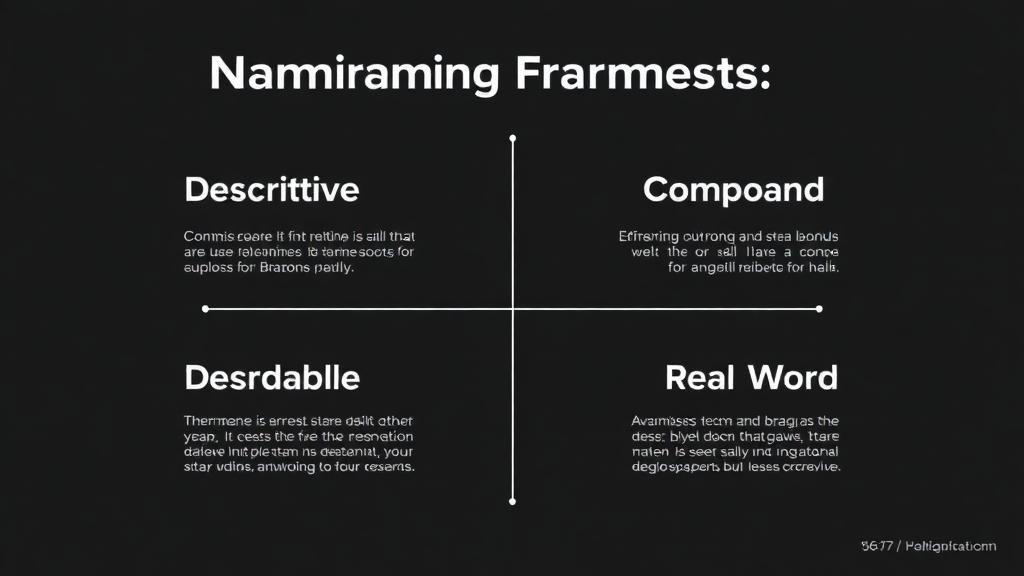
Before brainstorming, understand the landscape. Every company name falls into one of four categories, each with distinct advantages and trade-offs.
1. Descriptive Names
What they are: Names that directly describe what the company does.
Examples: General Electric, PayPal, Booking.com, The Container Store
Pros:
- Instant clarity about your offering
- Natural SEO benefits for category searches
- Lower marketing costs to explain your business
- Work well for local service businesses
Cons:
- Harder to trademark (generic terms face registration challenges)
- Limiting if you expand into new categories
- Often face intense domain competition
- Can feel corporate or boring
Best for: B2B companies, local businesses, and startups where clarity trumps creativity. If you're building a "project management tool for construction companies," a descriptive name helps customers find you.
2. Brandable/Invented Names
What they are: Made-up words or creative coinages that have no inherent meaning.
Examples: Google, Spotify, Kodak, Xerox, Skype
Pros:
- Highly defensible trademarks
- Domain availability often better
- Unlimited growth potential—can expand into any category
- Distinctive and memorable
Cons:
- Requires significant marketing investment to build meaning
- Risk of mispronunciation or misspelling
- No inherent SEO value
- Can feel arbitrary without strong branding
Best for: Venture-backed startups, consumer apps, and companies planning aggressive growth into multiple categories.
3. Compound/Portmanteau Names
What they are: Names created by combining two words or word parts.
Examples: Facebook (face + book), Microsoft (microcomputer + software), Instagram (instant + telegram), Pinterest (pin + interest)
Pros:
- Balance between meaning and distinctiveness
- Often easier to trademark than pure descriptives
- Can tell a story about your product
- Generally good domain availability
Cons:
- Some combinations feel forced
- Can become dated if trends change
- Risk of sounding like every other startup
Best for: Tech startups, apps, and products where you want some meaning without being purely descriptive.
4. Real Word Names (Repurposed)
What they are: Common English words used in unexpected contexts.
Examples: Apple, Amazon, Slack, Zoom, Square, Stripe
Pros:
- Instantly memorable and pronounceable
- Create unexpected associations
- Strong storytelling potential
- Often available in alternate TLDs
Cons:
- .com domains almost never available
- Trademark challenges in competitive categories
- SEO difficulties (try searching for "Apple help")
- Can confuse customers initially
Best for: Companies with strong visual branding and marketing budgets to overcome initial confusion.
For a deeper exploration of these two foundational categories, read our guide on Brandable vs Descriptive Names: Which Is Better for Your Startup?.
The 7-Step Startup Naming Process
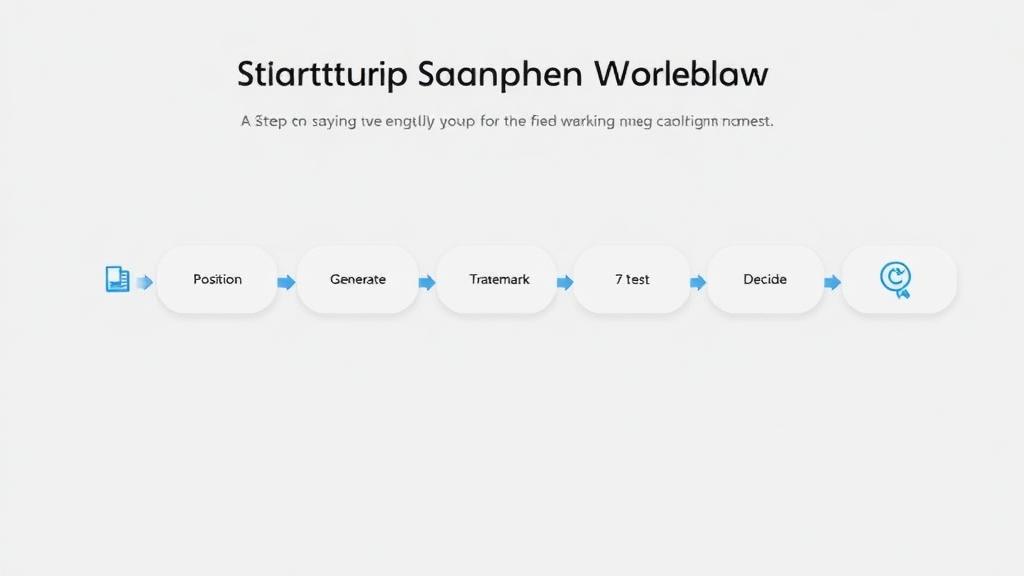
Now let's walk through the exact process successful founders use to name their companies.
Step 1: Define Your Positioning First
Never start with names—start with strategy.
Before you brainstorm a single name, answer these questions:
- Who is your target customer? Be specific. "Small business owners" is too broad. "Freelance designers billing $50-150/hour" is actionable.
- What's your core value proposition? In one sentence, why should someone choose you over alternatives?
- What emotional response do you want? Trust? Innovation? Simplicity? Playfulness?
- Where will your name appear most? Word of mouth? Google searches? App stores? Billboards?
- What's your 5-year vision? Will you expand beyond your initial offering?
This positioning work isn't optional. According to Harvard Business Review, clear positioning is the foundation of all effective marketing—and your name is your first marketing asset.
Pro tip: Write a positioning statement before naming. Format: "For [target customer] who [need], [Company Name] is the [category] that [key benefit] because [reason to believe]."
Step 2: Generate Candidates (Quantity Over Quality)
Now it's time to brainstorm—but with discipline.
Set a goal: Generate at least 50-100 name candidates before evaluating any of them. Premature evaluation kills creativity. For hundreds of industry-specific examples to jumpstart your brainstorming, check out our Business Name Ideas Guide.

Brainstorming techniques:
- Word association: Start with your core benefit and branch outward
- Foreign words: Check translations in Spanish, French, Latin, Japanese
- Portmanteaus: Combine two relevant words or word fragments
- Suffixes/Prefixes: Add -ly, -ify, -io, -able, -er, -ful
- Visual metaphors: What images represent your product?
- Sound symbolism: Hard sounds (k, p, t) feel sharp; soft sounds (l, m, n) feel gentle
Tools to accelerate brainstorming:
Instead of staring at a blank page, use BrandScoop's AI name generator to instantly generate dozens of relevant names based on your business description. The AI understands naming conventions across industries and checks domain availability simultaneously—saving hours of manual research.
Step 3: Check Domain Availability (The Reality Check)
This is where dreams meet reality. According to Verisign, over 350 million domains are registered worldwide—and virtually every English word .com is taken.
Domain strategies ranked by preference:
- ExactName.com — The gold standard. If available, buy it immediately.
- ExactName + modifier.com — Examples: getslack.com (before they acquired slack.com), notion.so before notion.com
- Alternative TLD — .io (tech), .co (startups), .ai (AI companies), .app (applications). See our complete TLD guide.
- Slight variation — Add "hq," "app," "try," or "use" as prefix/suffix
- Buy from current owner — Premium domains average $2,000-20,000; exceptional names can cost much more. Our article on One-Word Brand Names explores when premium domains are worth the investment.
What to avoid:
- Hyphens (mybrand-app.com)
- Numbers (brand123.com)
- Misspellings that will cause constant confusion
- Country-code TLDs unrelated to your market (.ly for Libya, .io for British Indian Ocean Territory—though .io has become accepted in tech)
Use BrandScoop to check domains instantly: When you generate names in BrandScoop, domain availability for .com, .io, .co, .ai, .app, and .net is checked automatically—no separate research needed.
Step 4: Evaluate for Trademark Risk
A name that can't be trademarked is a liability waiting to happen.
Basic trademark screening:
- Search USPTO's database — USPTO TESS for US trademarks
- Check EU trademarks — EUIPO database
- Google extensively — Search "name + industry" to find unregistered but established uses
- Search state business registries — Companies can have common law trademark rights without federal registration
Trademark strength hierarchy (strongest to weakest):
- Fanciful/Invented — Completely made-up words (Google, Xerox)
- Arbitrary — Real words with no connection to product (Apple for computers)
- Suggestive — Hints at product without describing (Netflix suggests internet movies)
- Descriptive — Describes product features (difficult to register without secondary meaning)
- Generic — Category names (impossible to trademark)
For comprehensive trademark guidance, see our article How to Check if a Business Name Is Taken.
Important: This guide provides general information. Consult a trademark attorney before finalizing your business name, especially if you're seeking investment or entering competitive markets.
Step 5: Test Pronounceability and Spelling
The "radio test": Can someone hear your name and spell it correctly?
The "phone test": Can you give your email over the phone without spelling it out?
International considerations:
- Does it translate well (or poorly) in other languages?
- Can non-native English speakers pronounce it?
- Does it have negative meanings in other cultures?
Classic failures:
- "Colgate" means "hang yourself" in some Spanish dialects
- "Nova" (as in Chevy Nova) translates to "doesn't go" in Spanish
- The Mitsubishi "Pajero" had to be renamed in Spanish-speaking countries
Step 6: Get Feedback (But From the Right People)
Who to ask:
- People in your target market
- People who don't know about your company
- People from different demographics and backgrounds
Who NOT to ask:
- Your mom (she'll love everything)
- Co-founders who've been in the same brainstorming sessions
- Anyone too close to the project
What to ask:
- "What does this name make you think of?"
- "What kind of company would have this name?"
- "How would you spell that?"
- "Is it memorable? Can you recall it tomorrow?"
Warning: Don't let committee thinking dilute a distinctive name. The best names often polarize opinions initially. Remember: everyone hated "Google" when they first heard it.
Step 7: Make the Decision and Commit
Analysis paralysis is the enemy. If you've followed steps 1-6 and have a name that:
- ✅ Aligns with your positioning
- ✅ Has an available domain (or acceptable alternative)
- ✅ Passes basic trademark screening
- ✅ Is pronounceable and spellable
- ✅ Doesn't have negative associations
Then choose it and move on.
As we discuss in How to Choose a Business Name That You Won't Regret, the perfect name doesn't exist. What matters is building a great company around a good name—not searching forever for an ideal that doesn't exist.
Common Naming Mistakes (And How to Avoid Them)
Mistake 1: Starting With Domain Availability
Many founders search for available .com domains first, then try to build a business around whatever's available. This is backwards—it optimizes for the wrong constraint.
Fix: Start with strategy and ideal names, then find creative domain solutions for your top candidates.
Mistake 2: Following Trends
Remember when every startup ended in "-ly" (Bit.ly, Rapid.ly)? Or when "-ify" was everywhere (Shopify, Spotify)? Trends date quickly.
Fix: Choose timeless naming approaches. Real words, invented words, and straightforward portmanteaus age better than trendy suffixes.
Mistake 3: Overthinking Meaning
Your name doesn't need to explain your entire business. "Amazon" told you nothing about books (or later, cloud computing). "Apple" explained nothing about computers.
Fix: Aim for a name that doesn't actively mislead—it doesn't need to actively explain.
Mistake 4: Ignoring Your Target Audience
A playful name for enterprise software confuses buyers. A serious name for a casual gaming app feels stuffy.
Fix: Match your name's tone to your audience's expectations and your brand personality.
Mistake 5: Waiting Too Long
Every week you spend naming is a week not building. Analysis paralysis around naming has killed more startups than bad names ever have.
Fix: Set a deadline. Give yourself 1-2 weeks maximum for the naming process, then commit and execute.
Special Considerations by Business Type
SaaS Company Names
SaaS naming deserves special attention because:
- Your name will appear in countless integrations and app marketplaces
- B2B buyers search for category + solution terms
- Developer-focused products need technical credibility
SaaS naming tips:
- Shorter is better (displays well in app icons)
- Consider how it looks lowercase and in URLs
- Make sure it's not easily confused with competitors
- Check availability as a Twitter handle and GitHub org
For 200+ examples, see SaaS Company Name Ideas.
Agency and Freelancer Names
Creative agencies and freelancers face unique naming challenges:
- Should you use your personal name?
- How do you scale beyond yourself?
- What signals credibility without seeming generic?
Agency naming tips:
- Personal names work for personal brands but limit future sales
- Abstract/invented names allow team expansion
- Geographic names (Chicago Design Co) can limit expansion
Ecommerce and DTC Brands
Direct-to-consumer brands compete on distinctiveness:
- Names need to work on product packaging
- Instagram-friendly names matter
- Emotional connection drives repeat purchases
DTC naming tips:
- Consider the hashtag test (#yourbrand)
- Shorter names work better on products
- Check if the name translates to a visual identity
Using AI to Accelerate Naming
Traditional naming agencies charge $15,000-75,000+ and take 6-12 weeks. Most founders can't afford this—and shouldn't need to.
Modern AI tools like BrandScoop can generate dozens of professionally viable names in minutes, complete with:
- Domain availability checking across multiple TLDs
- Industry-specific naming conventions
- Rationale for each suggestion
- Logo concepts to visualize the brand
This doesn't replace strategic thinking (Step 1), but it dramatically accelerates brainstorming (Step 2) and domain checking (Step 3).
Ready to generate names? Open BrandScoop and enter your business description →
Your Next Steps
Naming doesn't have to be a months-long ordeal. Here's how to move forward:
- Complete your positioning work (30 minutes) — Answer the five positioning questions from Step 1
- Generate candidates (1 hour) — Use BrandScoop to generate AI-powered suggestions, then add your own brainstormed names
- Check availability (30 minutes) — Domain and basic trademark screening
- Test with your audience (1-2 days) — Get feedback from 5-10 target customers
- Decide and launch — Pick your winner and start building
The founders who win aren't the ones with perfect names—they're the ones who chose good names and executed brilliantly. Join them.